Assembly and Installation
Installing the Adapter
The installation of the adapter is well shown in this video.
- Disassemble the T Display, be careful — the side covers on the buttons may fall out.
- Carefully unclip and remove the orange cover with the magnet.
- Reassemble it.
- Install the adapter as shown in the video, ensuring that the contacts and polarity match.
Firmware
- MultiProg ≥ 2.3.3 (with an activated TGSN_Open or TGSN_Full license).
- Internet on the MultiProg computer — needed to download the firmware and modules from our server.
- WiFi on the TGSN itself is NOT required for installation. (WiFi on the device is only needed if you later plan to self-update the firmware via the
Updatemenu directly on TGSN — see WiFi Setup on the Device below.)
Flashing is done via the TGSN → TGSN Install menu.
The process is split into 2 stages, with a manual device reset in between:
| Stage | What it does | Where to look |
|---|---|---|
| Stage 1: Flash | Downloads StartupFW + modules from the server, flashes the ESP32 | Status row: Stage 1: Flash, progress bar and log |
| (manual reset) | User resets TGSN with the button or reconnects USB | Reset page with a picture and the OK, device reset button |
| Stage 2: Install | Pushes the install data to TGSN over UART | Status row: Stage 2: Install → Pushing install data... |
Step 1. Plug in TGSN
Open TGSN → TGSN Install. A page appears with a connection picture and an "OK, plugged" button.
Connect TGSN to the computer via USB-C and click "OK, plugged".
MultiProg verifies that TGSN is responsive:
- If TGSN is detected — the dialog automatically switches to the programming page and starts Stage 1 immediately. No extra clicks needed.
- If TGSN is not detected — a message appears with a hint on what to do (typically: put TGSN into programming mode using its buttons). You stay on the plug page and can try again.
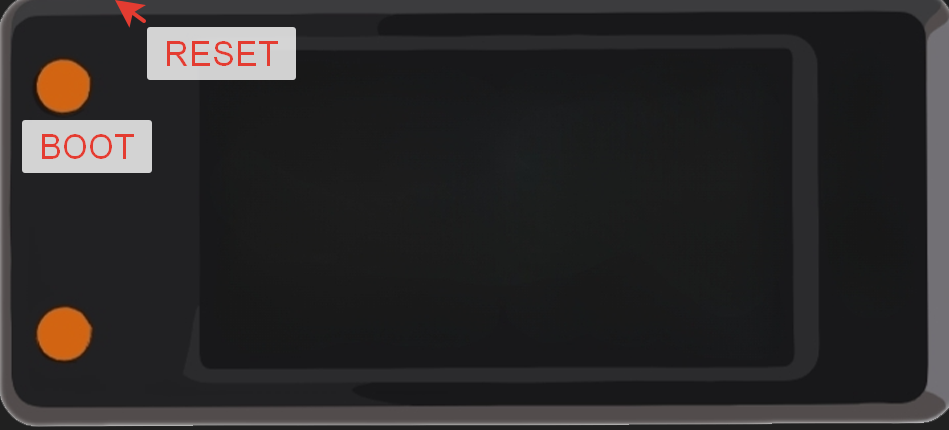
Put the T Display into programming mode using the buttons:
- Press and hold the reset button (on top, at the edge) and the boot button (top left).
- Hold for 2–5 seconds.
- Release reset, keep holding boot.
- Release boot.
Now click "OK, plugged" again.
Step 2. Stage 1 — Flashing StartupFW
After a successful USB check, MultiProg starts flashing automatically.
On the flashing page, you can check:
- FW Version — firmware version (fetched from the server at the start of the stage);
- Git Hash — firmware git hash.
- Log — text area with all messages (timestamps, errors, device echo responses).
- Cancel (bottom-left) — abort the installation at any moment.
- Retry (bottom-right, appears only after a failure) — retry from the start of the current stage without closing the dialog.
Nothing needs to be clicked at this step. Wait until MultiProg completes the first stage and asks you to reset the device.
For reference, the Step field can show these sub-steps at this stage:
Connecting to ESP32...— establishing communication with the ESP32 over USB.Fetching install package...— downloading the install package from the server.Downloading modules...— downloading family modules from the server.Verifying StartupFW...— verifying StartupFW integrity.Flashing StartupFW...— actually flashing the ESP32.
When Stage 1 completes, Step switches to Waiting for device reset... and the dialog moves to the reset page (Step 3).
- An error message appears.
- The Retry button becomes visible — clicking it re-runs Stage 1 from the start; the log is preserved.
- The Cancel button returns to the initial state (Stage =
Ready).
Step 3. Device reset
After a successful Stage 1, the reset page opens — a picture with a hint and two buttons.
When MultiProg asks for a reset, do one of the following:
- press the reset button on TGSN;
- or unplug and reconnect the USB cable.
Then click "OK, device reset".
If TGSN did not appear after reset, click "← Back" and start the installation again from the plug page.
Step 4. Stage 2 — Install
After clicking "OK, device reset", MultiProg checks that TGSN is back online and continues installation automatically.
At this stage, the install data is sent to the device over UART.
Adapter Hardware Test (HW Test)
During Stage 2, TGSN runs an adapter hardware test (HW Test) before install data is pushed. On the TGSN display this appears as TEST UART TGSN; in TGSN Install the same check is visible in the Step field and in the log.
The test sends a packet to TOOL0 and reads the echo back, checking the single-wire UART line and the adapter.
If the check fails or hangs, first verify the TGSN adapter is installed and seated correctly, then make sure TOOL0 is not still connected to the target board during installation.
If an error appears, click Retry. If the device did not appear after reset, click Back and start the installation again from the plug page.
Step 5. Completion
On a successful Stage 2, the completion page opens with a green check and the message "All steps completed!", and the Status row shows: Stage = Complete, Step = Done.
TGSN is ready to work 🚀
WiFi Setup on the Device (optional)
For the main TGSN workflow with MultiProg over USB, WiFi on the device is not needed.
WiFi on TGSN makes sense to set up if you want to:
- update the firmware directly from the device via the
Updatemenu (without MultiProg); - use features that require network access on the device side.
This is done via the separate menu item TGSN → TGSN Configure WiFi.
The dialog has 3 pages:
plugPage — confirm the connection
Same as in the installer: a connection picture and the "OK, plugged" button. After the click, MultiProg checks the connection to TGSN and:
- runs the StartupFW handshake;
- checks whether the device's NVS has a saved SSID:
- if it does — asks "Use saved <SSID>?": Yes → tries to connect immediately, No → switches to the network selection page;
- if it doesn't — switches to the network selection page.
wifiPage — network selection
- SSID list — combo-box, with a signal-bar icon next to each name.
- Re-scan — scan again.
- Password field — enter the password for the selected network.
- Connect WiFi — send the settings to TGSN.
On success, the dialog switches to the auth page.
authPage — authentication
Two tabs:
- Login — login/password of your kuraga.tech account. There is no Register here: by this point the account must already be registered on the website (without it MultiProg wouldn't have activated the license).
- Reset — password reset by token (if you forgot it).
MultiProg first checks whether the login/password are already saved in the device's NVS — if so, it does an auto-login without your involvement.
After a successful login, TGSN is considered fully set up.
Changing WiFi Settings / Changing the Account
To change the WiFi network or account on an already installed TGSN:
- Open
TGSN → TGSN Configure WiFi. - Confirm the connection → MultiProg itself will either offer to connect to the saved network or run a fresh scan.
- Enter the new settings.
StartupFW Version Control
When TGSN boots into StartupFW, the display shows:
- firmware version,
- git hash,
- build time.
The same information appears in the installer's Status row (FW Version / Git Hash fields), and after a successful installation — on the completion page (Model / Serial / Git Hash / Build ID fields).
This data is useful when contacting support.
What to do if something goes wrong
| Symptom | Where to look | What to do |
|---|---|---|
| "I plugged it in" → message "USB verification step…" | Message contains the specific cause | Check the USB cable, put TGSN into programming mode (BOOT/RESET) and click again |
| Stage 1 ended with an error | Step = Failed: <reason>, Retry button | Click Retry — installation continues from the start of Stage 1 (StartupFW + modules) |
| Stage 2 ended with an error | Step = Failed: <reason>, Retry button | Click Retry — Stage 2 is retried with the same data (no need to re-download from the server) |
| Device didn't reappear after reset | On the reset page | Click "← Back" → start the installation over from the plug page |
| TGSN won't connect to WiFi in Configure WiFi | Log on the wifiPage | Re-scan, enter the password again. If the error repeats — check that the network uses DHCP and has no MAC filtering |
| Login doesn't go through on the authPage | Log on the authPage | Check the login/password on the kuraga.tech site; if needed — Reset password via email |